What shipped in v2.0.0
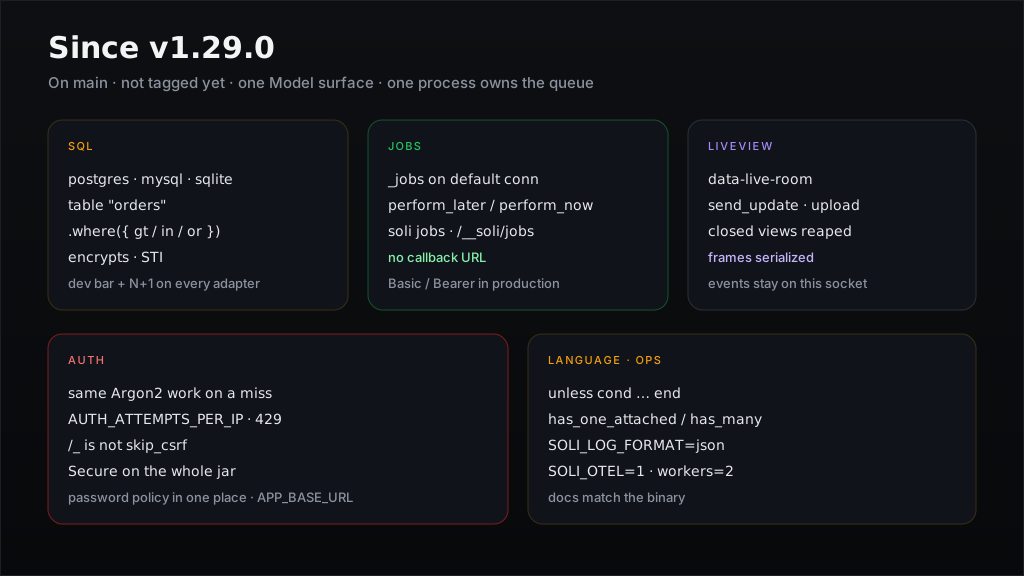
v1.29.0 shipped on 9 August; everything below landed in v2.0.0 on 31 August. This is a tour of that cycle — not a dump of the changelog. The exhaustive list lives on the changelog.
The short version: SQL is a real backend, jobs no longer phone home,
LiveView stopped leaking and leaking memory, and auth stopped helping
attackers. Plus unless … end is a real statement, and you can take
Stripe payments without a generator.
SQL is no longer a sketch
You can point Soli at Postgres, MySQL, or a SQLite file and keep the same
Model calls. Document tables (_key + doc) work everywhere. So do
column-aware models: table "orders" maps onto a schema you already have.
class Order < Model
  table "orders"
  belongs_to("account")
  has_many("line_items")
  encrypts(:tax_id)
end

class Admin < User
  # STI: same table, string `type` column
end
What that buys you on this cycle:
- Hash
.whereis a real vocabulary —{ "total": { "gt": 100 } },{ "id": [1, 2, 3] },{ "email": { "ilike": "%@x.com" } },{ "or": [{ "state": "draft" }, { "state": "open" }] }. Equality-only hashes (and a silent{ "gt": 10 }→==) are gone. .includes, HABTM,through:,.join(EXISTS),.havingon SQL. Three parents withincludes("books")is two queries, not four.- Atomic
increment/decrementand counter caches — 200 of 200 concurrent bumps on SQLite; the old read-modify-write kept 53. - Constraint violations become field errors on every adapter, not "sqlite column insert row: UNIQUE constraint failed…".
encryptsand STI on real columns. Missing text/typecolumns fail at boot, not at 2 a.m.- Migrations can create column tables (
pk,decimal(10,2),timestamps: true) and declareconnection "analytics". soli db:create/db:drop/db:schema:dump/db:schema:load.- The job queue indexes itself on first enqueue. Document
index "status"is real DDL the planner can use. - The dev bar,
dev_queries(), and N+1 detection work on SQL. They were SoliDB-only; the N+1 guard was blind on three of four backends. - SQLite is first-class — same Model surface, WAL + busy timeout +
foreign keys,
BEGIN IMMEDIATEtransactions, jobs via the write lock. One writer at a time;DECIMALis REAL affinity. Honest caveats, not a pretend Postgres.
Still refused on column mode: composite primary keys.
Pages: Multiple Databases, Postgres, MySQL, SQLite, Migrations.
Jobs live in your process
The queue is a _jobs collection on the default connection. A poller
claims due work (Postgres SKIP LOCKED, MySQL a token, SQLite the write
lock, SolidB If-Match). Workers run handlers. Soli owns retries,
leases, and cron.
There is no POST /_jobs/run/:name, no callback URL, no secret Stripe
(or SolidB) must use to reach you. Let the old SolidB queue drain before
you upgrade.
WelcomeEmailJob.perform_later({ "user_id": user.id })
WelcomeEmailJob.perform_now({ "user_id": user.id })   # tests: no queue

Cron.daily_at("08:00", "DigestJob")
Ops:
soli jobs/soli worker— claim and run with no HTTP listener (SOLI_JOB_WORKERS=0onsoli serve).soli jobs list/retry/cancel./__soli/jobs— same UI. Open in--dev. In production, setSOLI_JOBS_USER+SOLI_JOBS_PASSWORDand/orSOLI_JOBS_TOKEN. Unconfigured production is a 404.
See Jobs.
LiveView grew up
The Field Desk tutorial — A Live Field Desk — is the demo. Under it, the cycle closed a lot of holes.
Features you can use
- Nested
live_componentshares parent assigns;send_updateruns a child'sevent == "update"whenrouter_liveexists. data-live-room="name"— every tab joinsroom:name:component. A public board is one instance, not one per cookie-less socket.- Chunked
POST /live/uploadfor files over 256 KiB. soli-patch,soli-live, debounce/throttle, hooks, click-away,soli-disable-with, JS commands (add_class,focus,navigate…).has_one_attached/has_many_attached— disk, S3, or SolidB; a LiveView upload hash attaches as-is.
What stopped being a liability
- Closed views are released (2-minute grace, then reaped). They used to live for the process and keep waking on every subscribed write.
- Frames of one instance are serialized — a tick and a click no longer last-writer-wins each other's state.
- Events only hit the sending socket's instance.
- A raising handler reports an error; it does not increment the demo counter.
- Uploads are session-bound, capped (including in-progress chunks: 4 per session, 32 / 64 MiB global, 2-minute idle).
- A reconnect re-arms ticks.
- Render errors no longer leak absolute paths, and are escaped.
unless … end is a statement
It used to exist only as postfix, then as a desugared if !cond that
soli fmt turned into something else. It is StmtKind::Unless now.
unless ["up", "late", "overdue"].includes?(order.status)
  order.errors.add("status", "invalid")
end

unless cart.empty?
  checkout()
else
  redirect("/cart")
end

return cached unless cached.nil?
else is allowed. elsif is not. Formatter keeps unless. See
Control flow.
Auth that does not help the attacker
- Sign-in misses spend the same Argon2 work as hits. Lockout copy waits until the password verifies. One failure message.
- Per-IP throttle on sign-in, sign-up, and reset (
429). Shared budget:AUTH_ATTEMPTS_PER_IP/AUTH_IP_WINDOW_SECONDS(15 / 5 min). An existing lockout is not re-stamped. Keys on the peer unlessenable_trust_proxy(). User#password_errorowns the policy (AUTH_MIN_PASSWORD_LENGTH, default 12). Reset cannot install a password registration would refuse, and it drops the remember-me digest.SOLI_FORCE_SECURE_COOKIESis the whole jar, not justsession_id.same_site: "None"impliesSecure.- CSRF
/_exemption is gone. Only framework endpoints are skipped. YourPOST /_admin/wipeis gated. Useskip_csrfwhen you mean it (Stripe webhooks: the Stripe post). auth_base_urlreadsAPP_BASE_URL, nothttp://localhost:5011.rate_limiter_from_ip(req, limit, window_seconds)works — it was arity-2 and rejected the documented third argument.cargo audit --deny warningsis a CI gate.
soli generate oauth github|google is on this cycle too: state CSRF,
find-or-create, session login.
Faster where it is paid on every request
Hash overwrite no longer clones the key. req["params"]["id"] is one
VM opcode. Request plumbing skips work when there are no helpers, no
named routes, no middleware clock. That is the path every MVC action
walks.
Operations
SOLI_LOG_FORMAT=json— one NDJSON object per request.SOLI_OTEL=1— W3Ctraceparent, the same span tree as the dev-bar flamegraph, OTLP/HTTP off the request thread.- Production default workers: 2, not one-per-core.
- Slim Cargo features: drop
postgres/mysql/sqlite/pasetoyou do not need.
See Observability and Keeping memory low.
Docs that match the binary
This cycle also removed fiction: assert_equal, soli run file.sl,
--no-dev, Math.floor, DateTime .add_months(), five /docs URLs
that served JSON. The testing vocabulary, soli file.sl, and adapter
env vars on the configuration page are what the process actually does.
New writing: Stripe Checkout, Field Desk, dedicated SQL adapter pages.
If you are upgrading from 1.29
- Drain SolidB's old job queue before you rely on in-process jobs.
- Re-read CSRF if you had routes under
/_. - Set
SOLI_JOBS_USER/PASSWORDorSOLI_JOBS_TOKENif you want/__soli/jobsin production. - Set
APP_BASE_URLso auth mail does not point at localhost. - Column-mode models: add a string
typecolumn before you declare STI; only encrypt text columns.
The changelog page is the ledger. This post is the map.