Pipeline — lexer, parser, AST
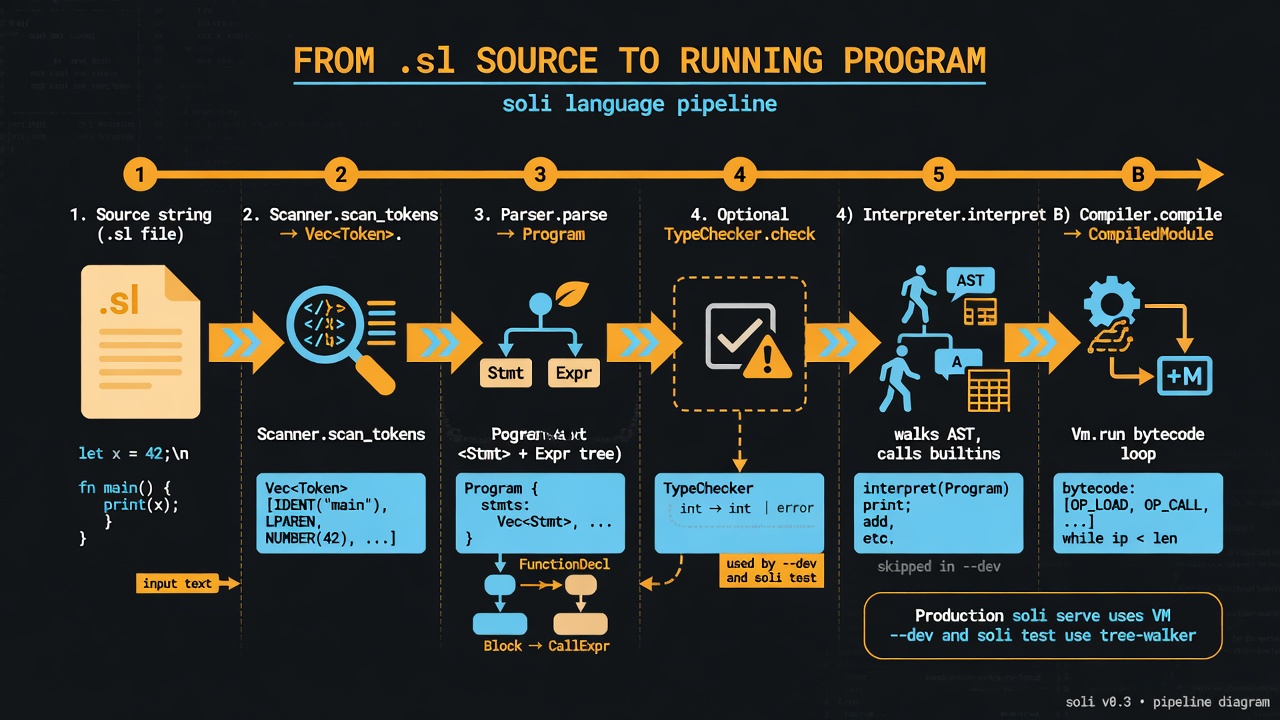
Every Soli file goes through the same front-end. Engines only diverge after a Program exists.
source: &str
    → Scanner::new(source).scan_tokens()  → Vec<Token>
    → Parser::new(tokens).parse()         → Program
    → optional TypeChecker::check
    → optional ModuleResolver::resolve    (imports)
    → Interpreter::interpret  or  Compiler::compile + Vm::run
You can see this literally in src/lib.rs (run_with_path, run_vm).
Spans
src/span.rs — Span { start, end, line, column }. Almost every AST node and every Token carries one. Errors (LexerError, ParseError, RuntimeError) use it to print file:line:col. When you add a node, copy the span from the token; a Span::default() makes the diagnostic land on line 1.
Lexer (src/lexer/)
| Type | File | Role |
|---|---|---|
Scanner<'a> | scanner.rs | Walks &str, emits tokens |
Token | token.rs | kind + lexeme + span |
TokenKind | token.rs | The enum of all tokens |
SdqlInterpolation | token.rs | #{expr} inside @sdbql{…} |
Scanner
pub struct Scanner<'a> { /* source, current, line, … */ }

impl Scanner<'_> {
    pub fn new(source: &str) -> Self
    pub fn scan_tokens(&mut self) -> Result<Vec<Token>, LexerError>
    pub fn scan_token(&mut self) -> Result<Token, LexerError>  // one token
}
scan_tokens loops scan_token until Eof. Keywords are matched after an identifier is scanned (so class is TokenKind::Class, not Identifier("class")).
Interpolation ("Hello #{name}"), raw strings ([[…]], """…""", r"…"), SDBQL blocks, and percent arrays (%w[a b]) are lexer features, not parser tricks.
Token / TokenKind
TokenKind is large: literals (int/float/decimal/string/bool/symbol), every keyword (Let, Class, Match, …), operators, and special forms (SdqlBlock, InterpolatedString).
If you add syntax:
- Add a
TokenKindvariant (or reuseIdentifier+ a keyword table). - Teach
Scannerto emit it. - Teach the parser to consume it.
- Add an AST node if the meaning is new.
Parser (src/parser/)
| File | Role |
|---|---|
core.rs | Parser struct, new, parse, token cursor (advance, check, match_token) |
declarations.rs | class, def, module, fields |
statements.rs | if, while, for, return, assignment |
expressions.rs | Pratt / precedence climbing |
precedence.rs | Operator table |
types.rs | Type annotations in the grammar |
pub struct Parser { /* tokens, current */ }

impl Parser {
    pub fn new(tokens: Vec<Token>) -> Self
    pub fn parse(&mut self) -> ParseResult<Program>
}
parse() returns Program { statements: Vec<Stmt> }. It is a recursive descent parser with a precedence table for binary operators (same idea as Crafting Interpreters).
Junior trap: the parser is split across files as impl Parser blocks. self.expression() in statements.rs is the same Parser. Search for fn expression rather than assuming one file owns it.
AST (src/ast/)
| File | Types |
|---|---|
expr.rs | Expr, ExprKind, Argument, NamedArgument |
stmt.rs | Stmt, StmtKind, Program, class/fn declarations |
types.rs | TypeAnnotation as parsed (not the checker’s interned types) |
Expr / Stmt are boxes around an enum + a Span:
pub struct Expr {
    pub kind: ExprKind,
    pub span: Span,
}
Important ExprKind families (not exhaustive):
- Literals:
IntLiteral,FloatLiteral,StringLiteral,BoolLiteral,Null,Symbol - Names:
Variable,This,Super - Operators:
Binary,Unary,Assign - Calls:
Call { callee, arguments },Pipeline - Access:
Member,SafeMember,Index,QualifiedName - Collections: array/hash literals, comprehensions
- Functions: lambdas
- Special:
CommandSubstitution,SdqlBlock,InterpolatedString
Argument is Positional(Expr) | Named(NamedArgument) | Block(Expr) — named params and do blocks are first-class in the tree.
The tree-walker matches on ExprKind. The VM compiles each variant to Ops. A new ExprKind without a compiler arm becomes an EngineFallback (handler silently runs on the interpreter in production after a failed compile). Prefer implementing both.
Type checker (src/types/) — optional
soli check calls TypeChecker::check. Annotations are optional; unannotated code is mostly Any. Controllers that render / redirect are notoriously hard to check — that is known, not a bug in your change.
| File | Role |
|---|---|
type_repr.rs | Internal type representations |
environment.rs | Type scopes |
checker/mod.rs | TypeChecker |
checker/expressions/ | Per-expression checking |
Modules (src/module/resolver.rs)
import "./foo.sl" is not handled by the parser as “load file”. The parser produces an import statement; ModuleResolver::resolve(program, path) splices imported declarations into the program. run_with_path only runs the resolver when the file has imports.
Errors
| Type | When |
|---|---|
LexerError | Bad character, unterminated string |
ParseError | Unexpected token |
RuntimeError | Division by zero, missing method, user throw |
SolilangError | Wrapper enum used by lib.rs |
From impls let ? bubble from scan → parse → interpret.