Internals — how the Rust crate is organized
This section is for people who will change the Soli interpreter, not for people writing Soli apps. If you are a junior Rust engineer joining the repo, start here, then follow the sub-pages.
Soli is one Cargo crate (solilang) that is both:
- a language (lexer → parser → AST → tree-walking interpreter or bytecode VM)
- a web framework (Hyper server, ORM, templates, LiveView, jobs) implemented as Rust builtins that Soli code calls
There is no separate “framework crate”. soli serve is the same binary as soli run.
Mental model in one picture
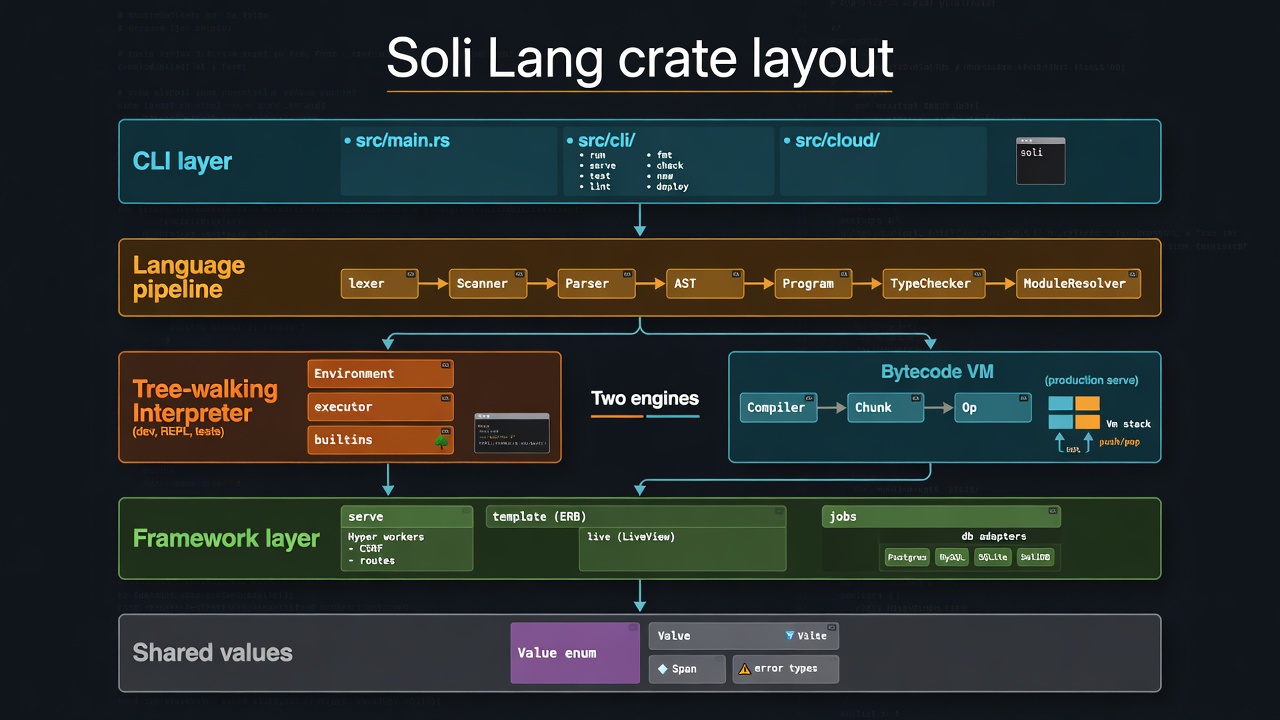
Layers: CLI → language pipeline → two engines → framework (serve, db, templates). Shared Value sits under everything.
Where to stand when you open the repo
| You want to… | Start in |
|---|---|
| Change syntax | src/lexer/, src/parser/, src/ast/ |
Change what 1 + 2 does | src/interpreter/executor/operators.rs and src/vm/vm.rs (dual engine) |
Add a builtin (File.read) | src/interpreter/builtins/ then a VM method table if it is a type method |
| Change HTTP / CSRF / workers | src/serve/ |
| Change SQL adapters | src/db/ |
| Change templates | src/template/ |
Change soli new / generators | src/scaffold/ |
| Change CLI flags | src/cli/ (src/main.rs only boots) |
Two binaries, one library
src/lib.rs— the library. All language and framework code lives here (pub mod …).src/main.rs— thesoliexecutable. Sets the allocator (mimalloc), a SIGTERM handler, SSRF test-runner token, thencli::run().src/cli/is compiled only into the binary (it ismod cliinmain.rs, notpub mod cliinlib.rs). Library tests cannot call CLI helpers unless they go through public lib APIs.
Entry points on the library:
Function (src/lib.rs) | What it does |
|---|---|
run / run_with_options / run_with_path | Lex, parse, optional type-check, tree-walk |
run_vm / run_file_vm | Same front-end, then bytecode VM |
type_check_source | soli check — no execution |
run_migration_source | Interpreter with SQL DDL builtins |
Production soli serve does not call run() per request. It boots workers that already hold a compiled (or interpreted) copy of the app. See Serve.
Dual engine (the tax you will pay)
| Mode | Engine | Why |
|---|---|---|
soli serve --dev, soli test, REPL | Tree-walking Interpreter | Readable stack traces, hot reload, no compile step |
soli serve production | Bytecode Vm | Throughput |
Every user-visible language feature must behave the same on both paths. There is a differential test suite (tests/differential_engines_test.rs) that runs programs through both engines. If you add a String method, you typically touch:
src/interpreter/builtins/(or executor)src/vm/vm_string_methods.rs(or the matchingvm_*_methods.rs)- tests on both sides
Skipping the VM copy means the feature works in --dev and silently differs in production.
Ownership patterns you will see everywhere
Soli values are cloned a lot (dynamic language). The crate leans on:
Rc<RefCell<T>>— arrays, hashes, instances (single-threaded per worker)EcoString(SoliStr) — strings; short strings inline, long strings refcountedArc— things that cross threads (compiled modules, HTTP futures, job payloads)- Thread-per-worker — each HTTP worker has its own
InterpreterorVm. No shared mutable AST across workers.
If you put a Rc in something that must go to another thread, the compiler will stop you. That is usually a sign the value should be Value serialized or Arc.
Request vs script
soli run file.sl     →  lib::run_with_path  → one Interpreter, exit
soli serve ./app     →  serve::serve_folder → load .env → boot gate →
                       worker pool → Hyper → CSRF → router → Soli action
Scripts have no filesystem jail. soli serve turns on File / Image jails under the app root.
Sub-pages
- Pipeline — lexer, parser, AST
- Interpreter —
Value, environment, executor, builtins - Bytecode VM — compiler, opcodes, dispatch
- Serve — HTTP workers, CSRF, boot
- Database adapters
- Rust API catalog — types and methods
How to add something (junior checklist)
- Find the existing similar feature. Copy its shape, don’t invent a third pattern.
- If it is language semantics, implement interpreter + VM or document an
EngineFallback. - Unit test next to the module (
#[cfg(test)]) plus a.sltest intests/when it is user-visible. cargo fmtandcargo clippy --all-targets -- -D warnings.- User-facing behavior:
CHANGELOG.md+www/docs/*.md+ matching.html.slv.
Crate module map (src/)
| Module | Role |
|---|---|
ast | Expr, Stmt, Program — the tree both engines consume |
lexer | Scanner → Token / TokenKind |
parser | Pratt parser → Program |
types | Optional static checker (soli check) |
module | import, packages, deploy tarball, preview envs |
interpreter | Tree-walk engine + all builtins |
vm | Compiler + stack VM |
compiled_cache | Cache compiled bytecode by source |
serve | HTTP server, MVC load, CSRF, static/file mode |
template | .html.slv / ERB renderer |
live | LiveView sockets, morph, uploads |
db | Postgres / MySQL / SQLite adapters + TLS |
jobs | Background job engine |
scaffold | soli new / generate |
lint / fmt | soli lint / soli fmt |
lsp | Language server |
graph | Code-graph for agents |
bundle / virtual_fs | .soli bundles and in-memory FS |
span / error / redaction | Locations, errors, secret scrubbing |
platform | OS process, locks, browser CDP |
desktop / update | Packaged apps, OTA |
coverage / metrics | Test coverage, Prometheus |
inflect | Inflections for generators |