Event Streaming from Soli with es — a Kafka-Shaped Broker You Can Actually Run
Most "event streaming" guides start by installing Java, then Kafka, then ZooKeeper (or KRaft, or Redpanda, or…), then a four-broker docker-compose.yml, then a schema registry. Forty minutes in, you still haven't published an event. For an app that just needs a durable, ordered log between two services — say, an order-created stream that a billing worker drains overnight — that's an enormous tax.
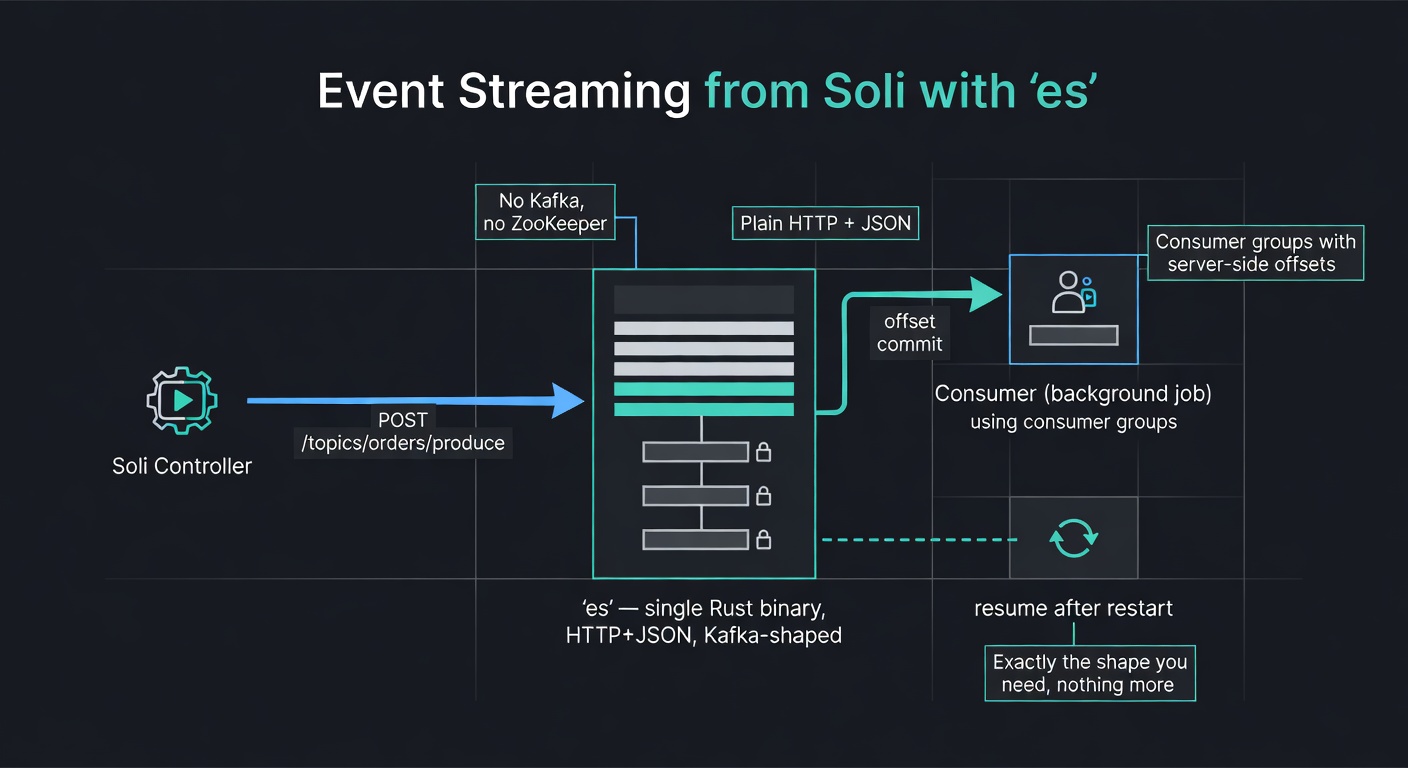
es is the answer to "what's the smallest thing with the shape of Kafka?" It's a single Rust binary that speaks plain HTTP+JSON, persists records to disk, supports topics with partitions, and tracks consumer-group offsets server-side. There's no Zookeeper, no KRaft, no protocol buffers, no client SDK to keep in lockstep. You produce with a POST. You consume with a GET. You commit an offset with another POST. That's the whole API.
This post wires es to a Soli app end-to-end: start the broker, create a topic, build a thin Es wrapper, emit events from a controller, and drain them with a background job that uses a consumer group so it can resume after a restart.
What es Looks Like on the Wire
Before any Soli code, the conceptual map. es exposes a small HTTP surface — small enough to fit in one table, with three logical groupings:
| Method + Path | Purpose |
|---|---|
GET /healthz | Liveness probe |
GET /metrics | Prometheus text-format metrics (size, lag, retention/compaction counters) |
GET /topics | List topics |
POST /topics | Create a topic with partitions: N and optional config patch |
GET /topics/:name | Describe (offsets, size, config per partition) |
GET /topics/:name/config | Read resolved topic config |
PUT /topics/:name/config | Patch topic config (retention, cleanup_policy, segment_bytes) |
POST /topics/:name/produce | Append records |
GET /topics/:name/consume?partition=…&offset=… | Read records at a position |
GET /groups/:group/consume?topic=…&partition=… | Read from a group's committed offset |
POST /groups/:group/commit | Advance the group's offset |
GET /groups/:group/offsets | Inspect what a group has committed |
POST /groups/:group/join | Join a group with a topic subscription; receive assigned partitions |
POST /groups/:group/heartbeat | Keep membership alive; learn when a rebalance is required |
POST /groups/:group/leave | Cleanly drop out of a group (triggers immediate rebalance) |
GET /groups/:group/assignment?member_id=… | Re-fetch the current assignment for a member |
POST /admin/run-retention | Force a synchronous retention pass (useful in tests) |
POST /admin/run-compaction | Force a synchronous compaction pass |
GET /admin/keys | List API keys (requires admin ACL) |
POST /admin/keys | Mint a new API key with ACLs + rate limits |
DELETE /admin/keys/:key_id | Revoke a key (soft-disable) |
GET /admin/producers | List idempotent-producer state (last seen seq + offset per partition) |
DELETE /admin/producers/:producer_id | Forget a producer's dedup state |
POST /admin/reset-offsets | Rewind every group on a topic back to its start_offset |
A record is {key, value, partition?}. The key is what routes the record to a partition (consistent-hash); pass partition explicitly if you want to override. Within a partition, records are strictly ordered and assigned a monotonic offset. That's the whole data model.
Step 1: Boot the Broker
es is a workspace with two binaries: es-broker (the server) and es (the CLI). Once built, the broker is one command:
$ es-broker --bind 127.0.0.1:9000 --data-dir ./data
INFO broker listening addr=127.0.0.1:9000
Then create the topic we'll use throughout the post. Three partitions is enough to demonstrate keying without making the example noisy:
$ es topic create --name orders --partitions 3
created topic 'orders' with 3 partition(s)

$ es topic describe --name orders
topic orders
  config:
    cleanup_policy         = delete
    segment_bytes          = 67108864
    tombstone_retention_ms = 86400000
    retention_ms           = (unset, infinite)
    retention_bytes        = (unset, infinite)
  partition 0  start=     0  end=     0  segments=1  size=0B
  partition 1  start=     0  end=     0  segments=1  size=0B
  partition 2  start=     0  end=     0  segments=1  size=0B
./data/topics/orders/ now holds an append-only log per partition. A redeploy of your Soli app doesn't touch it. A crash of es-broker doesn't lose acknowledged records — they're fsynced segments on disk.
That last sentence is true at the default --flush-every-records 1, which fsyncs after every append. If a benchmark shows you're disk-fsync-bound (typical past a few thousand records/sec on a single partition), the flag lets you batch — --flush-every-records 100 fsyncs once every hundred appends, trading up to ~99 un-fsynced records on a hard crash for an order-of-magnitude throughput bump. Records are still durable in the OS page cache the instant they're acked, so the loss window only opens on a kernel panic or power cut, not on es-broker segfaulting. Pick 1 for ledger-style data where every record matters; pick higher for telemetry where the producer can replay a small tail.
By default a topic is cleanup_policy = delete with infinite retention — the log grows forever. For a stream where consumers always catch up within a known window (most operational event streams), set a retention bound at create time so disk doesn't surprise you in production:
# Keep at most 7 days of orders, or 10 GiB, whichever bites first.
$ es topic create --name orders --partitions 3 \
    --retention-ms 604800000 \
    --retention-bytes 10737418240
You can change either bound later — es topic alter --name orders --retention-ms ... issues a PUT /topics/orders/config and a background reaper deletes segments older than the cutoff on its next pass.
Set an env var so the Soli app knows where to find the broker:
# .env
ES_BROKER=http://127.0.0.1:9000
Locking It Down with API Keys
By default es-broker accepts every request — perfect for localhost development, very wrong for production. Flip the broker into authenticated mode with one flag:
$ es-broker --auth required --data-dir ./data
WARN auth required + empty store: generated bootstrap admin key (secret written to file, rotate after first use) bootstrap_key_path="./data/keys/bootstrap.key"
INFO broker listening addr=127.0.0.1:9000 scheme=http
The first time you start with --auth required on an empty store, es generates a bootstrap admin key and writes the secret to ./data/keys/bootstrap.key (mode 0600). Read it once, use it to mint the keys you actually want, then delete the file:
$ export ES_AUTH=$(cat ./data/keys/bootstrap.key)

# A write-only key for the orders service, scoped to the "orders" topic prefix.
$ es key create --name orders-writer --acl write:orders
key_id: key_a3f12c
name:   orders-writer
acl:    write:orders

SECRET (shown once, save it now):
  esk_xK9pQ2vL...

# A read-only key for the billing drain.
$ es key create --name billing-reader --acl read:orders
key_id: key_b7d40e
name:   billing-reader
acl:    read:orders

SECRET (shown once, save it now):
  esk_mR3jH8cN...
The ACL grammar is action:topic_prefix — read, write, or admin, with * matching every topic. write: implies read: on the same prefix, so the writer can verify what it just produced; read: does not imply write:. Add --produce-bytes-per-sec 1048576 (or --consume-bytes-per-sec) when minting the key to cap a noisy neighbor — the broker enforces the budget per request and replies with 429 Too Many Requests plus a retry hint if the bucket runs dry.
Now the Soli app needs two env vars, one per service:
# Producer (controllers): .env on the web tier
ES_BROKER=http://127.0.0.1:9000
ES_AUTH=esk_xK9pQ2vL...

# Consumer (drain): .env on the worker tier
ES_BROKER=http://127.0.0.1:9000
ES_AUTH=esk_mR3jH8cN...
For a real deployment, also pass --tls-cert and --tls-key to the broker so the secret doesn't travel over the wire in clear. es-broker speaks rustls directly; no nginx in front needed.
Step 2: A Tiny Es Wrapper in Soli
Drop a wrapper in app/services/ so every controller, job, and script can produce and consume without repeating URL strings. Autoloading means no import line at the callsite.
# app/services/es.sl
class Es
  static def base
    getenv("ES_BROKER") || "http://127.0.0.1:9000"
  end

  # Build the auth headers. Returns an empty hash when ES_AUTH is unset, which
  # lets the same wrapper work against a `--auth disabled` broker in tests.
  static def headers
    token = getenv("ES_AUTH")
    return {} if token.blank?
    {"Authorization": "Bearer #{token}"}
  end

  # Append one or more records to a topic.
  # `records` is an array of {"key": ..., "value": ..., "partition": ..., "sequence": ...}.
  # Pass `producer_id` to opt into idempotent semantics — see "Making Retries Safe" below.
  static def produce(topic, records, producer_id = nil)
    url = "#{base}/topics/#{topic}/produce"
    body = {"records": records}
    body["producer_id"] = producer_id unless producer_id.blank?
    response = HTTP.post_json(url, body, {"headers": headers})
    check!(response, "produce", topic)
    response["body"].to_h
  end

  # Convenience: one record, value is serialized for us.
  # When `producer_id` is set, `sequence` must be a monotonically increasing
  # integer per `(producer_id, topic, partition)`.
  static def emit(topic, key, value, producer_id = nil, sequence = nil)
    record = {"key": key, "value": value.to_json}
    record["sequence"] = sequence unless sequence.nil?
    produce(topic, [record], producer_id)
  end

  # Read from a consumer group's committed position. Returns
  # {"records": [...], "next_offset": N, "high_watermark": N}.
  static def consume(group, topic, partition, max = 100)
    url = "#{base}/groups/#{group}/consume?topic=#{topic}&partition=#{partition}&max_records=#{max}"
    response = HTTP.get(url, headers)
    check!(response, "consume", topic)
    response["body"].to_h
  end

  # Advance the group's committed offset for this partition.
  static def commit(group, topic, partition, offset)
    url = "#{base}/groups/#{group}/commit"
    response = HTTP.post_json(url, {
      "topic": topic,
      "partition": partition,
      "offset": offset
    }, {"headers": headers})
    raise("es commit failed: #{response["status"]} #{response["body"]}") unless response["status"] == 204
    true
  end

  # Number of partitions on a topic — useful for fanning out a drain loop.
  static def partition_count(topic)
    response = HTTP.get("#{base}/topics/#{topic}", headers)
    check!(response, "describe", topic)
    response["body"].to_h["partitions"].length
  end

  # --- consumer-group coordinator ---

  # Join a group. Returns {"member_id": …, "generation": N, "assignment": [{topic, partition}, …]}.
  # Pass nil for `member_id` to let the coordinator pick one on first join.
  static def join_group(group, topics, member_id = nil)
    body = {"topics": topics}
    body["member_id"] = member_id unless member_id.blank?
    response = HTTP.post_json("#{base}/groups/#{group}/join", body, {"headers": headers})
    check!(response, "join", group)
    response["body"].to_h
  end

  # Heartbeat. Returns {"status": "ok"|"rebalance_required"|"unknown_member", "generation"|"current_generation": N}.
  # "rebalance_required" means: stop processing, re-join, get the new assignment.
  # "unknown_member" means: the coordinator evicted us (probably we were too slow); re-join.
  static def heartbeat(group, member_id, generation)
    response = HTTP.post_json("#{base}/groups/#{group}/heartbeat",
      {"member_id": member_id, "generation": generation},
      {"headers": headers})
    check!(response, "heartbeat", group)
    response["body"].to_h
  end

  # Clean shutdown: drop out of the group so the coordinator rebalances immediately
  # instead of waiting for our heartbeat to time out.
  static def leave_group(group, member_id)
    response = HTTP.post_json("#{base}/groups/#{group}/leave",
      {"member_id": member_id}, {"headers": headers})
    raise("es leave failed: #{response["status"]} #{response["body"]}") unless response["status"] == 204
    true
  end

  # Translate the broker's response codes into intelligible exceptions.
  # 401/403 means the ES_AUTH token is wrong or under-privileged — those will
  # never succeed on retry, so they should fail loudly. 429 is transient.
  static def check!(response, op, topic)
    status = response["status"]
    return if status == 200
    body = response["body"]
    case status
    when 401
      raise("es #{op} unauthorized — check ES_AUTH (topic=#{topic})")
    when 403
      raise("es #{op} forbidden — key lacks ACL for topic=#{topic}: #{body}")
    when 429
      raise("es #{op} rate-limited (topic=#{topic}): #{body}")
    else
      raise("es #{op} failed: #{status} #{body}")
    end
  end
end
A few choices worth flagging:
valueis serialized at the boundary.esrecords carry strings. We.to_jsononce inemitso callsites pass plain Soli hashes —Es.emit("orders", order.id.to_s, {"id": order.id, "total": order.total}).ES_AUTHis optional, not required.headersreturns{}when the env var is unset, so the wrapper works against an unauthenticated dev broker without anif dev …branch.- No client-side retry. A 5xx surfaces as a raised exception. The caller decides — a controller turns it into a 500 to the user; a job lets SolidB re-run it. 401/403 are surfaced distinctly because no retry policy will fix them; they mean "rotate the key or fix its ACL."
commitreturns 204. Treating any non-204 as failure catches bugs early.esis strict about this — silently accepting a 200 would mask a routing change.
Step 3: Produce from a Controller
A signup flow that emits an orders.created event after the row is persisted. The user gets their redirect; the billing worker, the analytics pipeline, the welcome-email job — all the downstream consumers wake up on their own schedule.
# app/controllers/orders_controller.sl
class OrdersController
  def create
    order = Order.create(params["order"])
    return {"status": 422, "json": {"errors": order._errors}} if order._errors

    # Key by user_id so every order for the same user lands in the same
    # partition — that's how `es` (and Kafka) preserve per-user ordering.
    Es.emit("orders", order.user_id.to_s, {
      "event":      "order.created",
      "order_id":   order.id,
      "user_id":    order.user_id,
      "total":      order.total,
      "currency":   order.currency,
      "created_at": Time.now.iso8601
    })

    redirect("/orders/#{order.id}")
  end
end
Two design notes:
- The event is
order.created, notCharge stripe and email the user. Producers describe what happened; consumers decide what to do. That's what makes this scalable later — a new consumer (fraud scoring, say) joins the topic without the controller knowing it exists. - The key is
user_id, notorder.id. All of a single user's orders are guaranteed to be processed in submission order by a single consumer. Different users may interleave, which is exactly what you want for throughput.
If the broker is briefly down, the HTTP.post_json raises, the controller returns a 500, and the user retries. There's no in-memory queue eating the event. That's a deliberate tradeoff: at the cost of one extra network hop in the happy path, you get a story for failure that the user understands. If you need fire-and-forget producing, wrap the Es.emit in a BillingEmitJob.perform_later({...}) — but most apps don't.
Making Retries Safe with producer_id
The naive retry above has one subtle hole: what if the broker did accept the record and only the HTTP reply was lost? The user retries, the controller calls Es.emit again, and now there are two order.created events for the same order. The billing drain charges Stripe twice.
es closes that gap with opt-in idempotent producing. Tag a request with a stable producer_id and a monotonic sequence per (producer_id, topic, partition), and the broker dedupes retries automatically:
class OrdersController
  # One producer_id per process. The broker remembers what sequences it has
  # already seen under this id, and a retry of the same (id, partition, seq)
  # returns the original offset with duplicate=true instead of re-appending.
  PRODUCER_ID = "web-#{getenv("HOSTNAME") || "local"}"

  def create
    order = Order.create(params["order"])
    return {"status": 422, "json": {"errors": order._errors}} if order._errors

    Es.emit("orders", order.user_id.to_s, {
      "event":    "order.created",
      "order_id": order.id,
      "user_id":  order.user_id,
      "total":    order.total
    }, PRODUCER_ID, order.id)

    redirect("/orders/#{order.id}")
  end
end
The mechanics worth knowing:
- Sequence must be strictly increasing within a partition, with no gaps. The broker rejects
expected N, got N+2with400 sequence gap. Usingorder.idworks as long as the database guarantees monotonic IDs per row; if two orders for different users land in different partitions (which is what user-keyed partitioning does), each partition just sees a subset of the global sequence, but each subset is still monotonic — which is what the broker checks. - Duplicates return the original offset, not a new one.
ProduceResult.duplicate == truetells you "I already had this; here's where it landed the first time." The drain side sees one record, not two. - Producer state is durable on the broker side. It survives broker restarts (persisted alongside topic data). To wipe it — say, after rotating a
producer_id— usees producer revoke --id web-orders-1.
If you don't need this, skip it. The argument is optional; controllers that call Es.emit("orders", key, value) without the extra args keep the old at-least-once behavior. Reach for producer_id when the consumer can't tolerate duplicates and the producer might retry — typically anything that drives an external side-effect (Stripe, SES, a webhook).
Step 4: Drain with a Consumer Group
The consumer is the interesting half. We want:
- Resumable — restart the worker without re-processing what's already done.
- Per-partition parallelism — three partitions, three drains, three times the throughput.
- At-least-once delivery — handlers may run twice on a crash; they must be idempotent.
A consumer group on es gives us the first two for free; the third is on us.
# app/jobs/orders_drain_job.sl
class OrdersDrainJob
  GROUP_NAME = "billing"
  TOPIC      = "orders"
  BATCH_SIZE = 200

  static def perform(args)
    partition = args["partition"]

    loop do
      page = Es.consume(GROUP_NAME, TOPIC, partition, BATCH_SIZE)
      records = page["records"]

      break if records.blank?

      for record in records
        handle(record)
      end

      # Commit *after* every record in the batch is handled. If the worker
      # crashes mid-batch, the next run replays from the last commit — that's
      # the at-least-once guarantee.
      Es.commit(GROUP_NAME, TOPIC, partition, page["next_offset"])

      # If the page wasn't full, we've drained to the high-water mark.
      break if records.length < BATCH_SIZE
    end

    {"partition": partition, "drained_to": page["next_offset"]}
  end

  static def handle(record)
    payload = JSON.parse(record["value"])

    case payload["event"]
    when "order.created"
      BillingService.charge(payload["order_id"])
    when "order.refunded"
      BillingService.refund(payload["order_id"])
    end
  end
end
Three subtleties:
- Commit happens after the handler returns, not before. If
BillingService.chargeraises mid-batch, the loop unwinds without committing, and the next run sees the same records again. That's the at-least-once contract — combined with an idempotency key on the billing side (e.g.order_idas Stripe'sIdempotency-Key), double delivery is harmless. break if records.blank?—next_offset == high_watermarkshows up as an empty page. That's the natural signal to stop a drain.partitionis a job argument. The scheduler runs oneOrdersDrainJobper partition in parallel. Schedule them with a tiny dispatcher:
# app/jobs/orders_dispatcher_job.sl
class OrdersDispatcherJob
  static def perform(args)
    partition_count = Es.partition_count("orders")
    for p in 0..partition_count - 1
      OrdersDrainJob.perform_later({"partition": p})
    end
  end
end
Schedule the dispatcher every minute — or every five seconds, depending on how fresh you want the billing pipeline to be. The cost of a drain that finds nothing is one HTTP GET; cheap enough to poll aggressively if you want sub-second latency without leaning on long-poll.
Letting the Broker Assign Partitions
The dispatcher above is fine when you know how many drain workers exist and which partitions each should handle. The moment you want to scale by adding worker processes — or survive a worker crashing without one partition's stream falling silent — the static fan-out stops being enough. You'd be reinventing the part of Kafka that does this for you.
es does it for you too, now. Every worker calls join_group("billing", ["orders"]), the broker assigns each one a slice of the partitions, and a heartbeat-based failure detector triggers an automatic rebalance when a worker dies. The drain code stays almost identical — only the source of partition changes from "a job argument I hard-coded" to "whatever the broker told me to drain on this generation."
# app/workers/orders_worker.sl
class OrdersWorker
  GROUP_NAME    = "billing"
  TOPIC         = "orders"
  HEARTBEAT_MS  = 5_000        # send before the coordinator's 30s timeout fires
  BATCH_SIZE    = 200

  static def run
    state = Es.join_group(GROUP_NAME, [TOPIC])
    member_id  = state["member_id"]
    generation = state["generation"]
    assignment = state["assignment"]

    log_info("joined #{GROUP_NAME} as #{member_id} (gen #{generation}): #{assignment}")

    last_beat = Time.now
    loop do
      for tp in assignment
        # tp is {"topic": "orders", "partition": N}
        drain_partition(tp["partition"])
      end

      # Heartbeat at most once per HEARTBEAT_MS — also our chance to learn that
      # the coordinator wants us to rebalance.
      if (Time.now - last_beat) * 1000 >= HEARTBEAT_MS
        beat = Es.heartbeat(GROUP_NAME, member_id, generation)
        last_beat = Time.now

        case beat["status"]
        when "ok"
          # carry on
        when "rebalance_required"
          log_info("rebalance triggered, re-joining")
          state      = Es.join_group(GROUP_NAME, [TOPIC], member_id)
          generation = state["generation"]
          assignment = state["assignment"]
        when "unknown_member"
          # We were evicted. Start fresh — coordinator will mint a new id.
          state      = Es.join_group(GROUP_NAME, [TOPIC])
          member_id  = state["member_id"]
          generation = state["generation"]
          assignment = state["assignment"]
        end
      end

      sleep(0.2)
    end
  ensure
    # Clean shutdown speeds up rebalance for the rest of the group from "30s
    # heartbeat timeout" to "immediate."
    Es.leave_group(GROUP_NAME, member_id) rescue nil
  end

  static def drain_partition(partition)
    loop do
      page = Es.consume(GROUP_NAME, TOPIC, partition, BATCH_SIZE)
      records = page["records"]
      break if records.blank?

      for record in records
        handle(record)
      end
      Es.commit(GROUP_NAME, TOPIC, partition, page["next_offset"])
      break if records.length < BATCH_SIZE
    end
  end

  static def handle(record)
    # … same as OrdersDrainJob.handle above
  end
end
What the coordinator gives you, beyond the static dispatcher:
- Scaling by adding workers. Run two
OrdersWorkerprocesses — each gets ~half the partitions. Run six — each gets one (for a 6-partition topic). No code changes, no redeploy. - Failover without manual intervention. Stop sending heartbeats (worker crashed, network partitioned, GC pause too long) and within
member_timeout(30s default) the coordinator evicts the dead member and reassigns its partitions to the survivors. The replays land at the survivor's nextEs.consume— at-least-once guarantees do the rest. - A real shutdown story.
Es.leave_groupin anensureblock turns a SIGTERM into an immediate rebalance, instead of the group waiting for the heartbeat timeout. Production rolling deploys depend on this.
When to keep the static dispatcher: single worker process, fixed deployment, you'd rather schedule via Soli's job runner than run a long-lived consumer. When to switch to join_group: anytime you want to scale horizontally or tolerate worker failure.
Step 5: Inspect from the CLI
es ships with a CLI that talks to the same HTTP API, which means the operator's view and the app's view are identical. No "Kafka tools" rabbit hole.
# What partitions does the topic have, how full are they, and what's the config?
$ es topic describe --name orders
topic orders
  config:
    cleanup_policy         = delete
    segment_bytes          = 67108864
    tombstone_retention_ms = 86400000
    retention_ms           = 604800000
    retention_bytes        = 10737418240
  partition 0  start=     0  end=    47  segments=1  size=14256B
  partition 1  start=     0  end=    52  segments=1  size=15732B
  partition 2  start=     0  end=    49  segments=1  size=14808B

# Where is the billing group sitting? Are we caught up?
$ es group show --name billing
topic orders
  partition 0 -> offset 47
  partition 1 -> offset 52
  partition 2 -> offset 49

# Tail one partition without touching the group's committed offset:
$ es consume --topic orders --partition 0 --offset 40 --max 5
p=0 off=40 ts=1748039210123 key=Some("17") value={"event":"order.created","order_id":98,...}
p=0 off=41 ts=1748039211004 key=Some("23") value={"event":"order.created","order_id":99,...}
…
-- next_offset=45 high_watermark=47 (5 record(s))
That third command is the unsung hero of debugging. You can read events from any offset without disturbing the consumer group — perfect for the "what was the payload of that event 200 records ago?" question. The same /topics/:name/consume endpoint backs it, which means an admin page in your Soli app can offer it too with a five-line controller action.
For continuous observability, point Prometheus at /metrics:
$ curl -s http://127.0.0.1:9000/metrics | grep -E 'es_(group_lag|partition_size)' | head
es_partition_size_bytes{topic="orders",partition="0"} 14256
es_partition_size_bytes{topic="orders",partition="1"} 15732
es_partition_size_bytes{topic="orders",partition="2"} 14808
es_group_lag{group="billing",topic="orders",partition="0"} 0
es_group_lag{group="billing",topic="orders",partition="1"} 0
es_group_lag{group="billing",topic="orders",partition="2"} 0
es_group_lag is the single most useful number to alert on — it's the distance between the high-water mark and the group's committed offset. If billing falls behind by, say, 10k records for more than a minute, the worker is stuck. Wire that into Grafana and you've got the operational view that takes a Kafka deployment a weekend.
If you turned on --auth required, es key list rounds out the audit story — which keys exist, what they're allowed to do, and which have been revoked:
$ es key list
key_a3f12c  orders-writer
  acl: write:orders
key_b7d40e  billing-reader
  acl: read:orders
key_c91f30  old-debug-key [revoked]
  acl: admin:*
es key revoke --id key_c91f30 flips the disabled flag in ./data/keys/api_keys.json and the broker rejects further requests carrying that secret with 401. The secret itself is never stored — only its SHA-256, so a stolen api_keys.json doesn't leak credentials, only their hashes.
For coordinator-driven groups, es group join and es group assignment are the operator's window into who's holding what:
# Simulate a worker (or use it as a manual consumer in a pinch).
$ es group join --name billing --topic orders
member_id:  m-3f12c8
generation: 4
assignment:
  orders/1
  orders/2

# What does this particular member think it owns right now?
$ es group assignment --name billing --member-id m-3f12c8
generation: 4
assignment:
  orders/1
  orders/2

# Drop the member; the coordinator rebalances within milliseconds.
$ es group leave --name billing --member-id m-3f12c8
For the idempotent-producer side, es producer list shows what the broker remembers about each known producer — the last sequence it accepted and where it landed on disk. That's the diagnostic you reach for when something looks like it was double-charged or skipped:
$ es producer list
producer web-orders-1
  topic=orders partition=0 last_seq=4831 last_offset=4831
  topic=orders partition=1 last_seq=4775 last_offset=4775
  topic=orders partition=2 last_seq=4812 last_offset=4812
And es reset-offsets --topic orders is the "I've cleaned everything up, every consumer group should re-read from the current start" button. Useful after a destructive cleanup (manual segment deletion, a partition rebuild) where the committed offsets no longer make sense. It's a sharp tool — every group on the topic gets rewound, not just one — so it should sit in your runbook, not in any drain code.
Why This Composition Holds Up
The pieces sit on three deliberate boundaries:
Esdoesn't know about orders or billing. It speaks records. If you add apaymentstopic tomorrow,Es.emit("payments", ...)works without changes.- The controller doesn't know about billing. It describes the event and is done. A new consumer (analytics, fraud) joins by subscribing — there's no editing the producer.
- The drain job doesn't know about the broker. It calls
Es.consume. Swapesfor Kafka tomorrow by reimplementingEsagainst Kafka's REST proxy and the job is untouched. - Auth lives entirely inside the wrapper. Callers never reference
ES_AUTHorAuthorization. Rotating the writer's key is a deploy that changes one env var — no controller code moves. The wrapper is also where 401/403 get a meaning: "rotate the key" vs. "broker is sick" is a distinction the caller would otherwise have to learn.
That layering is also why the whole thing fits in three files plus a wrapper. Kafka's bigness is largely about features you don't have yet — cross-topic transactions, schema registries, geo-replication. es punts on all of them. If you ever need them, you migrate. Until then, you ship.
One subtlety worth knowing about even if you never touch it: es-broker can listen on a second port with --bind-binary 127.0.0.1:9001, exposing a length-framed binary protocol (ES01 magic, opcodes for Produce/Consume/Ping) that carries native Vec<u8> keys and values. It exists for the case where JSON parse cost or UTF-8 round-tripping becomes a measurable bottleneck — typically a Rust-side ingestion service flushing millions of records a second. From Soli, stick with HTTP+JSON; you have HTTP builtins and not a custom-framing builtin, and the JSON path comfortably keeps up with anything a Soli app produces in a single request. The binary path is a future you can grow into without rewriting the producer/consumer model.
When to Reach for es vs. What You Already Have
Soli has two adjacent tools that overlap with es:
- SolidB-backed background jobs (covered in Sending Email with SendGrid) — durable, retried, scheduled. The difference: a job is a unit of work to do once; a topic is a stream of facts other systems will read repeatedly, in order. Use jobs for "send this email"; use
esfor "every order ever placed, replayable by any consumer." - WebSocket broadcasts — pushed to connected clients, ephemeral, no replay. Use WS for "tell every open dashboard a new order came in"; use
esfor "let the billing service catch up on the last hour of orders after a deploy."
You'll often want both. A controller can Es.emit and ws_broadcast in the same request: the event lands in the durable log for the billing drain, and the live order board updates in real time. The two are orthogonal.
What's Next
A few directions to extend this:
-
Dead-letter handling. A handler that has raised three times in a row probably won't succeed on the fourth. Track per-record attempt counts in a SolidB collection keyed by
(topic, partition, offset)and route the record to adead_letterstopic instead of blocking the drain. -
Schema validation. A
to_hround-trip is generous about what comes in. Validate the payload's shape withUser.validate(...)(or a JSON Schema check) insidehandleand route bad records to aparse_failurestopic. -
Compacted topics for current-state streams. When the stream represents state rather than facts —
user.profile_updated,cart.contents_changed,account.balance— you don't want the full history, you want the latest value per key. Create the topic with--cleanup-policy compact, write the current state as thevalue(withnullvalue to tombstone a key), and the broker keeps only the most recent record per key forever:$ es topic create --name user_profiles --partitions 3 --cleanup-policy compactA late-joining consumer reads from offset 0 and gets a snapshot of every user that has ever existed, in O(distinct keys) records instead of O(history). Combine with
--cleanup-policy compact,deleteif you also want a time bound — e.g. "latest per user, but drop users untouched for 90 days."
The producer is one line. The consumer is fifteen. The broker is one process. That ratio — three small, well-named pieces — is what makes event streaming feel like a tool rather than an architecture decision.