Sending Email with SendGrid — and Doing It from a Background Job
Architecture note (superseded). This post describes the original design, in which SolidB owned the queue and delivered work back to the app through a signed
POST /_jobs/run/:namewebhook. Soli now runs jobs in-process: the queue is a_jobscollection on your default connection (SolidB, PostgreSQL, MySQL, or SQLite), a poller claims work atomically, worker threads execute it, and Soli owns retries and cron. There is no callback URL, no inbound route, and no required callback secret. The public API (Job.*,Webhook.*,Cron.*,perform_later,static cron) is unchanged. See Background Jobs and Cron for the current behaviour.
Email delivery is one of those features that quietly turns a synchronous request into a slow one. The user submits a signup form, your controller posts to SendGrid's API, the API takes 300 ms on a good day and several seconds on a bad one — and the user waits. The fix is not "make HTTP faster"; the fix is to take the work off the request path entirely.
This post walks through two things together: building a thin SendGrid wrapper as an app/services/ class, then handing the delivery off to a SolidB-backed background job so the controller returns immediately. By the end you will have a SendGrid.send_mail(...) you can call from anywhere, an EmailJob you can enqueue with one line, and a clear mental model of why those two pieces belong on opposite sides of the queue.
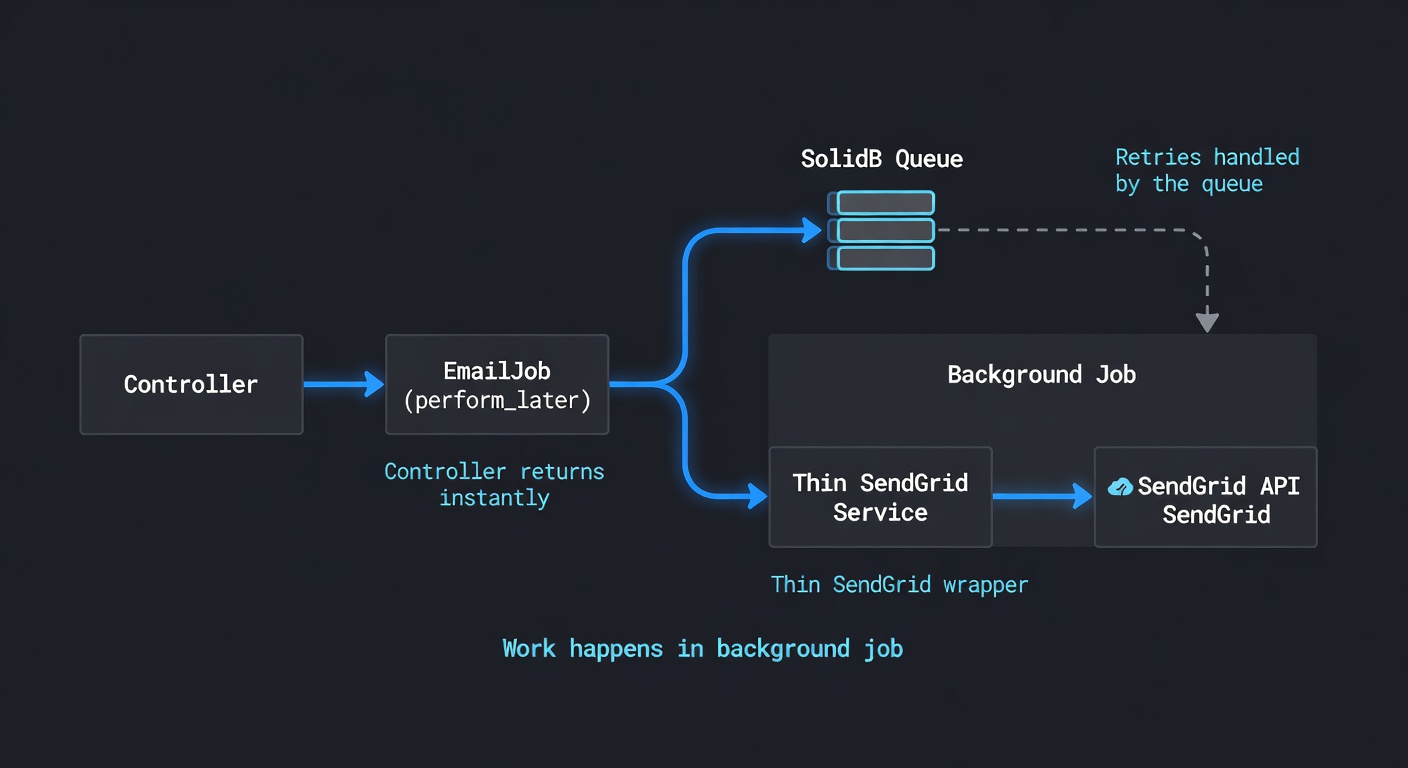
The Shape of the Solution
Three files and a route do the whole job:
app/services/sendgrid.sl             # thin wrapper around the v3 Messages API
app/jobs/email_job.sl                # static perform — receives args, calls SendGrid
app/controllers/users_controller.sl  # enqueues EmailJob.perform_later(...)
The controller never touches SendGrid. It validates input, persists the user, enqueues an email, and returns. The job runs out-of-band on a worker triggered by SolidB and is the only piece that talks to api.sendgrid.com.
Step 1: A Thin SendGrid Wrapper
Wrap the SendGrid v3 Messages API once, in a place you can reuse from any job, controller, or one-off script. Drop it in app/services/ — Soli autoloads every .sl file under that directory at boot, so the class is available everywhere without an import.
# app/services/sendgrid.sl
class SendGrid
  SEND_URL = "https://api.sendgrid.com/v3/mail/send"

  static def send_mail(to, subject, body, from = nil)
    api_key = getenv("SENDGRID_API_KEY")
    if api_key == nil or api_key == ""
      raise("SENDGRID_API_KEY is not set")
    end

    sender = from
    if sender == nil or sender == ""
      sender = getenv("SENDGRID_FROM") || "no-reply@example.com"
    end

    payload = {
      "personalizations": [{"to": [{"email": to}]}],
      "from": {"email": sender},
      "subject": subject,
      "content": [{"type": "text/plain", "value": body}]
    }

    response = HTTP.post_json(SEND_URL, payload, {
      "headers": {
        "Authorization": "Bearer #{api_key}",
        "Content-Type": "application/json"
      }
    })

    # SendGrid returns 202 Accepted on success, with an empty body.
    if response["status"] >= 200 and response["status"] < 300
      return {"ok": true, "status": response["status"]}
    end

    {"ok": false, "status": response["status"], "body": response["body"]}
  end
end
A few things to notice:
getenv("SENDGRID_API_KEY")is read insidesend_mail, not at module load. That means changing the key in.envand hot-reloading does the right thing in dev. It also means each call pays for one cheap env lookup — trivial compared to the HTTP round trip.HTTP.post_jsondoes the JSON serialization andContent-Typefor us. We still setAuthorizationexplicitly because that's the API contract.- A 202 with an empty body is the success case. Treating any 2xx as
ok: truekeeps the wrapper boring; the caller decides what to do with non-2xx. - No retry logic in the library. Retries belong to the queue, not to the library. SolidB will re-fire the job if the handler raises or returns a 5xx — letting the wrapper stay thin.
Because app/services/ is autoloaded, you call SendGrid.send_mail(...) from any controller, job, or script without an import line.
Step 2: The Email Job
Now the asynchronous half. Soli's background-job system loads every class under app/jobs/, registers a static perform(args) entry point, and gives you perform_later, perform_now, perform_in, and perform_at for free. The full mechanics live in /docs/jobs; the short version is:
# app/jobs/email_job.sl
class EmailJob
  static def perform(args)
    to      = args["to"]
    subject = args["subject"]
    body    = args["body"]
    from    = args["from"]

    result = SendGrid.send_mail(to, subject, body, from)

    if !result["ok"]
      # Raising re-surfaces a 5xx back to SolidB, which schedules a retry.
      raise("SendGrid rejected #{to}: #{result["status"]} #{result["body"]}")
    end

    result
  end
end
Two design choices worth flagging:
argsis a plain hash. Job arguments round-trip through JSON via SolidB's queue, so primitive types only — no model instances, no closures, no dates asTimeobjects. Pass IDs and strings; rehydrate insideperformif you need the record.- Failure is communicated by raising. Soli's
/_jobs/run/:nameroute turns an uncaught exception into a500. SolidB sees the 500, incrementsattempt, and re-enqueues per its retry policy. There's no separate "tell the queue I failed" call — the absence of a normal return is the signal.
Step 3: Enqueue from a Controller
This is the line the user actually waits for:
# app/controllers/users_controller.sl
class UsersController
  def create
    user = User.create(params["user"])
    if user._errors
      return {"status": 422, "json": {"errors": user._errors}}
    end

    EmailJob.perform_later({
      "to":      user.email,
      "subject": "Welcome to Acme",
      "body":    "Hi #{user.name}, your account is ready."
    })

    redirect("/users/#{user.id}")
  end
end
perform_later calls Job.enqueue("EmailJob", args) under the hood, which POSTs the job to SolidB's /_api/database/{db}/queues/{queue}/enqueue endpoint. SolidB acks the enqueue in a few milliseconds and the controller returns. Whatever SendGrid is doing — and however many seconds it spends doing it — happens out of sight on a worker that gets called back by SolidB later.
Want to delay the send instead? Same API, different verb:
EmailJob.perform_in("2 minutes", {"to": user.email, "subject": "...", "body": "..."})
EmailJob.perform_at("2026-06-01T08:00:00Z", {"to": user.email, "subject": "...", "body": "..."})
Want to run it inline for a test? EmailJob.perform_now({...}) skips the queue entirely and calls perform in-process.
Step 4: Why SolidB Owns the Queue
The job system uses SolidB for three things that would otherwise be three different pieces of infrastructure:
- Durable storage of pending work. When SolidB acks the enqueue, the job survives a Soli restart, a crash, and a redeploy. The user does not have to retry signup just because you shipped a hotfix.
- Scheduling.
perform_inandperform_atare queue inserts with anot_beforetimestamp. SolidB releases them when their time arrives — no second Cron daemon, noatjob, nosetTimeout. - Retries. A 5xx from the callback tells SolidB to re-fire after a backoff. You declare the retry policy on the SolidB side; Soli's contract is "return a status code." This is exactly the boundary you want: the language runtime doesn't pretend to know how many times to retry the API.
Configure it with three env vars (SOLI_JOBS_DATABASE, SOLI_JOBS_CALLBACK_URL, SOLI_JOBS_SECRET) and the system bootstraps itself. The full table — including the HMAC-SHA256 signing scheme that protects the /_jobs/run/:name route from being called by anything other than SolidB — is in /docs/jobs#configuration.
Why This Pattern Holds Up
Two boundaries make this clean:
- The library doesn't know about the queue.
SendGrid.send_mailis a synchronous function. It works in a controller, a script, asoli consolesession, or a test. Pulling SendGrid into a separate file like this means a future "send a password reset" feature wires up the same wrapper into aPasswordResetJobwithout copying API code. - The controller doesn't know about SendGrid. It enqueues an email by intent (to, subject, body), not by transport. If you swap SendGrid for SES tomorrow, you touch
app/services/sendgrid.slandEmailJob. The controller and the SignupForm don't care.
That separation is what lets the request return in 10 ms while the email still goes out a second later — the user gets their redirect, the email shows up, and you never had to put SendGrid's latency into your SLO.
What's Next
A few directions to extend this:
- Templates. Replace the plain-text body with SendGrid dynamic templates — pass
"template_id"and"dynamic_template_data"instead of"content"in the payload. The wrapper grows by ~10 lines and your controllers stop building HTML strings. - Per-queue routing.
EmailJob.set(queue: "mailers").perform_later(...)puts welcome emails and transactional alerts on different SolidB queues so a backlog in one doesn't starve the other. - Idempotency. SolidB hands you
args["job_id"]andargs["attempt"]on retries. Stamp the user record withwelcome_email_sent_atafter a successful send and short-circuit on attempt > 1 if the field is already set.
The wrapper, the job, and the queue are intentionally small. Adding any of the above is changing one of the three files — not rewiring the architecture.