Tamper-Evident Audit Logs in Soli, from Two Primitives
Most "audit logs" are a lie waiting to happen. They're a table, and a table can be
UPDATEd. If someone with database access edits a row — a transaction amount, an
approval timestamp, who accessed a record — nothing about the log itself reveals
that it happened. For compliance, finance, healthcare, or anything with a legal
retention requirement, a log you can silently rewrite is worth exactly nothing.
The fix is old and well understood: hash-chain the records, the way a blockchain does, minus the distributed-consensus circus you almost never need. Each record commits to the one before it, so changing any record after the fact breaks every hash that follows — and that break is detectable by anyone, forever.
Soli ships the two primitives that make this a few lines of code rather than a
subtle crypto project: Crypto.canonical_json and Crypto.merkle_root (alongside
the Crypto.sha256 you already know). Let's build a real, verifiable ledger with
them.
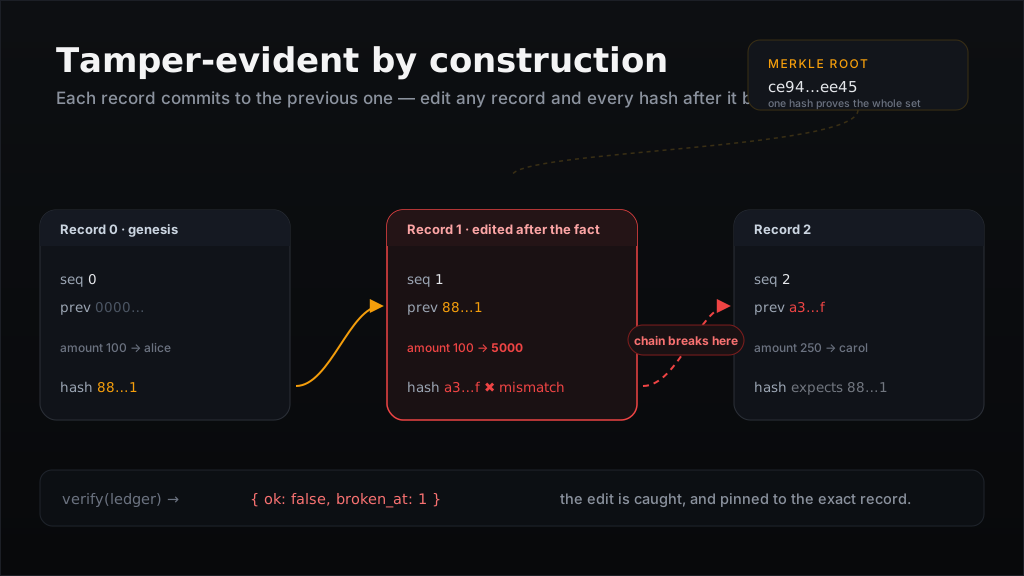
verify() pins the break to the exact record.The one hard part: stable bytes
A hash is only as good as the bytes you feed it. Hash the same record twice and get
two different digests, and your chain is broken before it starts. This is the trap
that sinks most hand-rolled attempts, because ordinary JSON serialization is not
stable: object key order follows insertion order, so { "a": 1, "b": 2 } and
{ "b": 2, "a": 1 } — the same record, loaded two different ways — serialize to
different strings and hash to different values.
Crypto.canonical_json fixes exactly this. It sorts object keys lexicographically,
recursively, so the same logical content always produces the same bytes:
Crypto.canonical_json({ "amount": 100, "to": "alice" })   # {"amount":100,"to":"alice"}
Crypto.canonical_json({ "to": "alice", "amount": 100 })   # {"amount":100,"to":"alice"}
Two dictionaries, same bytes. Now a hash of that is a stable content fingerprint you can recompute anywhere, any time.
Chaining the records
A ledger record carries its business data plus three chain fields: a monotonic
seq, the prev_hash of the record before it, and its own hash. The hash commits
to the previous hash, the sequence number, and the canonical content:
const GENESIS = "0000000000000000000000000000000000000000000000000000000000000000"

def append(chain, data)
  let prev = chain.length() == 0 ? GENESIS : chain[chain.length() - 1]["hash"]
  let seq  = chain.length()
  let hash = Crypto.sha256(prev + ":" + str(seq) + ":" + Crypto.canonical_json(data))
  chain.push({ "seq": seq, "prev_hash": prev, "hash": hash, "data": data })
  return chain
end
Because each hash folds in the previous record's hash, the records form a chain:
edit record #3's amount, and record #3's hash no longer matches — and so does not
match the prev_hash that record #4 committed to, and #5, and every record after.
One tampered row invalidates the entire tail.
Let's write a few:
let ledger = []
ledger = append(ledger, { "actor": "alice", "action": "transfer", "amount": 100 })
ledger = append(ledger, { "actor": "bob",   "action": "approve",  "ref": 1 })
ledger = append(ledger, { "actor": "alice", "action": "transfer", "amount": 250 })
Verifying integrity
Verification is just re-deriving the chain and checking that every stored hash matches what the content actually produces. The first mismatch is your tamper point:
def verify(chain)
  let prev = GENESIS
  for rec in chain
    let expected = Crypto.sha256(prev + ":" + str(rec["seq"]) + ":" + Crypto.canonical_json(rec["data"]))
    if expected != rec["hash"]
      return { "ok": false, "broken_at": rec["seq"] }
    end
    prev = rec["hash"]
  end
  return { "ok": true, "count": chain.length() }
end

print(verify(ledger))   # {ok => true, count => 3}
Now play the adversary. Someone with write access quietly bumps a historical amount:
ledger[1]["data"]["amount"] = 5000   # rewrite an approved record after the fact
print(verify(ledger))                # {ok => false, broken_at => 1}
The edit is caught, and pinned to the exact record. No matter how the row was changed — through the app, through a raw SQL console, through a restored backup — the chain math doesn't care. If the bytes changed, the hash changed, and verification fails.
One hash to prove the whole set: the Merkle root
Re-verifying a million-row ledger on every check is wasteful, and handing a regulator a million hashes to compare is absurd. A Merkle root collapses the entire set into a single hash. Publish that one value — in a report, a signed email, even a public blockchain for third-party notarization — and anyone can later re-derive it from the records and confirm nothing changed.
let leaves = ledger.map(fn(r) r["hash"])
let root   = Crypto.merkle_root(leaves)
# e.g. "ce947049b20eac714a134d9bcdfd9e72eeb1522bbd8a4fa2deb7a255ea22ee45"
Crypto.merkle_root pairs leaves as sha256(left ‖ right) up the tree until one hash
remains. Change any leaf — or even reorder them — and the root changes. It's the
compact commitment you archive daily: a 64-character string that proves the integrity
of everything underneath it.
Wiring it into a Model
In a real app you don't hand-roll the array — you persist records and compute the
chain against the tail. The pattern drops straight into a model's before_create
callback, where the record is about to be written:
class LedgerEntry < Model
  before_create("chain")

  def chain
    let tail = LedgerEntry.order("seq", "desc").first()
    this.prev_hash = tail.nil? ? GENESIS : tail.hash
    this.seq       = tail.nil? ? 0 : tail.seq + 1
    this.hash      = Crypto.ledger_hash(this.prev_hash, this.seq, this.to_h())
  end
end
Two conveniences show up here. instance.to_h() returns the record's user fields as a
hash — exactly what you want to hash. And Crypto.ledger_hash(prev, seq, data) is a
one-call shorthand for the sha256(prev ":" seq ":" canonical_json(data)) formula
above, so your write path and your verifier can share a single definition and never
drift apart.
What this is, and what it isn't
Be honest with yourself about the threat model. A hash chain is tamper-evident, not tamper-proof: an attacker who can rewrite records and recompute the whole chain from their edit forward can produce a self-consistent forgery. What defeats that is anchoring — periodically publishing the Merkle root somewhere you don't control (a counter-signed report, a notary, a public chain), so the attacker can't also rewrite history's published fingerprints. The chain makes silent edits impossible; anchoring the root makes undetectable edits impossible.
That's the whole point: not a cryptocurrency, not consensus, not a P2P network — just an append-only log whose integrity anyone can verify with two builtins and a loop. For audit trails, financial ledgers, provenance records, and compliance logs, that's exactly the guarantee you actually need.