Multiple Databases in One Soli App
Soli was SoliDB-native by design: one connection, one backend, the full ORM surface (graph, vector, timeseries, raw SDBQL) in a single process. That is still the right default for most apps.
It is also an adoption wall. Real shops do not empty Postgres on day one. They have a billing warehouse on MySQL, a legacy order table on PostgreSQL, and a product domain that deserves SoliDB's document + search stack. Forcing everything onto one engine is how frameworks lose RFPs.
So Soli now does what Rails and Laravel already expect — named connections, declared in config, chosen per model — without pretending every backend has the same capabilities.
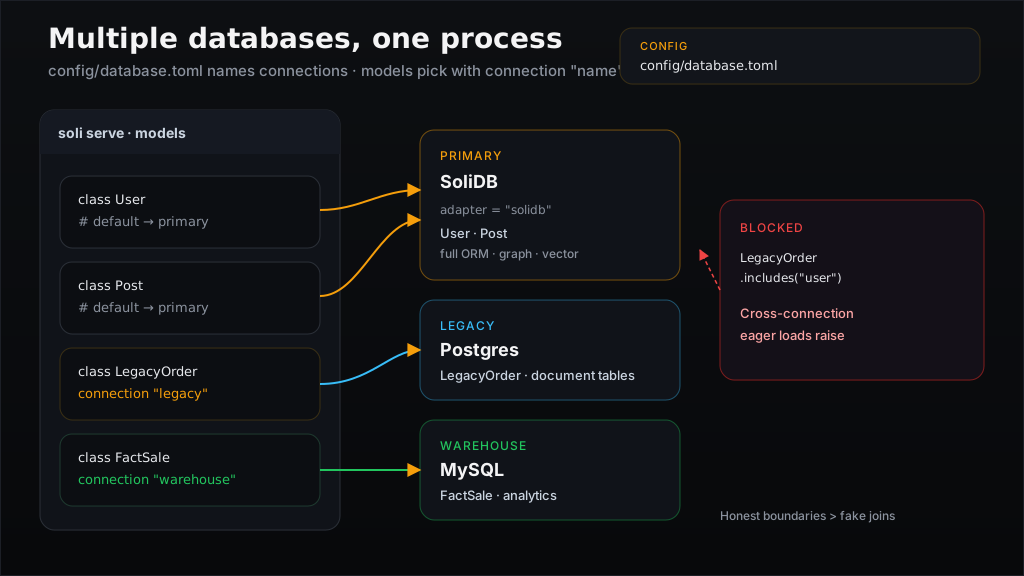
The problem with a single global adapter
Until now, Soli's SQL work and SoliDB work shared a process-wide switch:
# Entire app is SoliDB…
# (default)

# …or entire app is Postgres document tables
SOLI_DB_ADAPTER=postgres
DATABASE_URL=postgres://…
That is enough to run a brownfield CRUD app on Postgres or MySQL (the Phase 2/3
SQL document backend: _key + JSON/JSONB doc, hash .where, aggregates, batched
.includes, group_by, migrations). It is not enough to compose backends.
is_sql() was global. Every model used the same pool. Hybrid "SoliDB for product,
Postgres for legacy" was impossible without two processes.
The shape: config/database.toml
Named connections live next to routes, not only in the environment:
# config/database.toml
default = "primary"

[connections.primary]
adapter = "solidb"
host = "${SOLIDB_HOST:-http://localhost:6745}"
database = "${SOLIDB_DATABASE:-default}"
username = "${SOLIDB_USERNAME:-}"
password = "${SOLIDB_PASSWORD:-}"

[connections.legacy]
adapter = "postgres"
url = "${LEGACY_DATABASE_URL}"
pool = 10

[connections.warehouse]
adapter = "mysql"
url = "${WAREHOUSE_DATABASE_URL}"
pool = 5
${VAR} and ${VAR:-default} expand from the environment after .env loads, so
secrets stay out of git while the topology of the app stays reviewable.
If the file is missing, nothing breaks: env alone still defines a single connection
named primary. Existing apps keep working.
The API: one line on the model
class User < Model
  # uses default ("primary") — SoliDB in the example above
end

class LegacyOrder < Model
  connection "legacy"
end

class FactSale < Model
  connection "warehouse"
end
That class-body DSL mirrors soft_delete, scopes, and indexes: registered at
model load, stored on metadata, inherited by STI children unless redeclared.
From there the runtime does the boring, important work:
- Resolve the connection name (model → collection map, or registry default).
- Activate it for the duration of the query or write.
- Use a per-name SQL pool (Postgres/MySQL), not one process-wide
OnceLock. - Fail loudly if you ask for a connection that is not in the file.
What works on SQL (honest matrix)
SQL adapters are a document subset, not a secret second SoliDB.
| Capability | SoliDB | Postgres / MySQL docs |
|---|---|---|
| CRUD, validations, callbacks | ✓ | ✓ |
Hash .where / order / limit / count | ✓ | ✓ |
| sum / avg / min / max | ✓ | ✓ |
Batched .includes (belongs_to / has_many / has_one) | ✓ | ✓ |
Multi-row group_by | ✓ | ✓ |
HABTM / through includes, .having, .join | ✓ | ✗ |
| Graph, vector (pgvector later), columnar, timeseries | ✓ | ✗ |
Model.transaction | ✓ | ✗ |
The point of the matrix is product trust. Silent half-support is how people learn to hate multi-DB features.
The rule that keeps you honest: no cross-connection includes
# LegacyOrder is on Postgres. User is on SoliDB.
LegacyOrder.includes("user").all
# → error: spans database connections ("legacy" → "primary")
You can still store a foreign key. You cannot pretend a join across two network services is free. Fetch each side deliberately, or put both models on the same connection when they are a true aggregate.
That is deliberate. Distributed joins and 2PC are out of scope. The feature exists to place models, not to invent a federated database.
Migrating data onto SQL
For the brownfield path, import is a first-class command:
SOLI_DB_ADAPTER=postgres DATABASE_URL=postgres://…
SOLIDB_HOST=… SOLIDB_USERNAME=… SOLIDB_PASSWORD=…
soli db:import posts users
Each SoliDB document becomes a row in a _key + doc table. Same shape the Model
layer already uses on SQL. No relational schema reverse-engineering step for the
document case.
Mental model vs Rails / Laravel
| Rails | Soli | |
|---|---|---|
| Config | database.yml + env | config/database.toml + env expansion |
| Per-model | connects_to / establish_connection | connection "name" |
| Default | primary | primary (or default = in TOML) |
| Hybrid engines | Multiple adapters | SoliDB and Postgres/MySQL in one process |
| Cross-DB associations | Usually discouraged | Hard error on eager load |
The killer case for Soli is not "five Postgres shards." It is SoliDB for the product core + SQL where the data already lives.
flowchart LR
  subgraph app [soli serve]
    U[User]
    P[Post]
    L[LegacyOrder]
    F[FactSale]
  end
  subgraph primary [connection primary]
    SDB[(SoliDB)]
  end
  subgraph legacy [connection legacy]
    PG[(Postgres)]
  end
  subgraph warehouse [connection warehouse]
    MY[(MySQL)]
  end
  U --> SDB
  P --> SDB
  L --> PG
  F --> MY
What we are not shipping yet
Honesty beats a roadmap slide:
- Per-connection SoliDB hosts — the registry knows the fields; routing every SoliDB HTTP/driver call through the active named host is the next wiring step.
soli db:migrate --connection warehouse— migrations still target the default connection until that flag lands.- Request-scoped roles (
writing/readingreplicas) — Rails multi-db middleware territory; not v1. - pgvector on the document store — still SoliDB-only (or a later dedicated design), not a pretend checkbox.
Getting started
- Keep using env-only
primaryif one database is enough. - When you need a second engine, add
config/database.tomland name both. - Mark only the models that truly live elsewhere:
class BillingInvoice < Model
  connection "legacy"
end
- Read the capability matrix before you move graph or vector features off SoliDB.
Why this fits Soli
Soli's bet has always been minimum surface, maximum utility. Multi-database does not invent a new ORM dialect. It reuses the Model API you already know, puts topology in a file you can code-review, and refuses the lies that make multi-DB features toxic (silent cross-DB joins, "transactions" that are not).
One process. Named connections. Per-model choice. SoliDB where it shines; SQL where the data already is.
Design notes and the full matrix live in
docs/sql-adapter-design.md (repo: docs/sql-adapter-design.md).